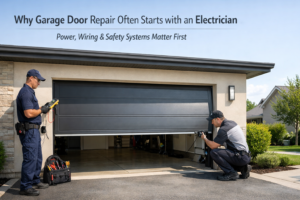
Garage door problems often seem simple on the surface. The door won’t open, the remote stops responding, or the opener makes a strange sound and shuts down. Most homeowners immediately assume it’s a mechanical issue—something with the springs, rollers, track, or motor. But in reality, many garage door failures begin long before the door itself shows signs of damage. They start with power, wiring, and electrical reliability.
That’s why garage door repair often starts with an electrician.
Because if the system isn’t receiving clean, stable electricity—or if the wiring behind the walls is compromised—no amount of mechanical adjustment will make the door function the way it should. And more importantly, electrical issues can create safety risks that are far more serious than an inconvenient door that won’t move.
The Garage Door Is a Mechanical System Powered by Electricity
A garage door is one of the most mechanical features of a home. It has a heavy door panel, moving sections, rollers, tracks, lifting cables, and springs under intense tension. But the moment you press the button, the system instantly becomes electrical. The opener relies on power. The safety sensors rely on power. The wall control relies on power. Even the “smart features” rely on a stable connection to electrical current and low-voltage control wiring.
That’s where an electrician becomes essential.
Power Problems Look Like Garage Door Problems
One of the most common misunderstandings in garage door repair is that an electrical fault can mimic a mechanical failure. For example, a door that stops halfway might look like it needs spring adjustment or new rollers. But many times, the opener is simply losing power under load. That can happen when there’s a loose connection, weak circuit, failing outlet, or breaker issues.
Homeowners see the symptoms on the door. Professionals recognize that the root cause could be inside the electrical system.
When the garage door opener starts and suddenly shuts down, when the lights flicker on the opener, or when the wall button randomly stops responding, those aren’t just “door issues.” They’re warning signs that something electrical may not be stable.
Garage Door Openers Are Sensitive to Voltage Drops
Modern garage door openers have circuit boards, sensors, internal logic controls, and built-in safety functions. They’re much more advanced than older units that could tolerate irregular power. These systems are designed to shut down or behave unpredictably when power becomes inconsistent.
Voltage drops can happen for several reasons:
A home circuit overloaded by multiple appliances
A loose connection at the outlet or junction box
Old wiring that can’t carry power efficiently anymore
A weak breaker that trips under stress
Extension cords or improper wiring to the opener
When voltage drops or fluctuates, the opener might stop, reverse, beep, or flash lights as if something is “wrong with the door.” But in reality, the opener is protecting itself.
In those cases, the garage door repair begins with verifying the power supply.
Sensors, Wall Buttons, and “Phantom Problems”
Safety sensors are one of the most important parts of any garage door system. They prevent accidents by detecting objects, pets, or children in the path of the door. But these sensors are low-voltage devices, and low voltage systems are especially vulnerable to wiring issues.
If the sensor wires are damaged, stapled too tightly, exposed to moisture, or simply worn out over time, the opener may behave like the sensors are blocked—even when nothing is there. The door may close halfway and reverse, or refuse to close entirely unless you hold the wall button down.
At that point, many homeowners wipe the sensors, adjust their angles, and hope for the best. But if the wiring is compromised, cleaning won’t solve anything.
That’s when an electrician (or a technician with strong electrical troubleshooting skills) becomes the first step—not the last.
Breakers, GFCIs, and Outlet Failures Are Common Culprits
Garage door openers are typically plugged into a ceiling outlet. That outlet may be connected to a GFCI circuit, sometimes in a bathroom, kitchen, or garage itself. Many homeowners don’t realize this until their garage door stops working and the opener appears “dead.”
A tripped GFCI outlet can silently cut power to the garage door opener. So can a weak breaker that trips occasionally. So can an outlet that loses tension and no longer makes firm contact with the plug.
All of these issues can present the same way: a door that won’t open, no response from the remote, and no power in the opener at all.
In these cases, the right repair approach is not to start replacing garage door parts. The first step is confirming that power is present, stable, and correctly wired.
That is electrician-level troubleshooting.
Improper DIY Electrical Work Can Cause Dangerous Failures
Another major reason garage door repair starts with an electrician is because many garages contain DIY electrical modifications. It’s extremely common for homeowners or previous contractors to install garage outlets, lights, or even opener wiring shortcuts without doing it to code or without using proper junction boxes and connectors.
Over time, those shortcuts can lead to:
Loose wires that arc and create heat
Melting insulation around connections
Outlets that fail under load
Random power losses during operation
Fire hazards behind walls or ceilings
A garage door opener draws meaningful power when lifting a heavy door. If the wiring is unsafe, every use of the door becomes a risk—not just a repair issue.
Smart Garage Doors Add Another Layer of Electrical Dependence
Smart openers are convenient, but they also add complexity. These systems often integrate:
Wi-Fi connectivity
Backup batteries
LED lighting systems
Sensors and smart modules
Security locks and monitoring
When something fails, homeowners often assume it’s an app issue or a “bad opener.” But smart systems can fail due to power instability, incorrect grounding, or wiring that isn’t delivering consistent voltage to the unit.
That’s why a professional repair should evaluate electrical health before assuming the technology is defective.
Electrical Repairs Protect the Motor and Extend the System’s Life
A garage door opener is not meant to struggle. If it’s underpowered, constantly stopping mid-cycle, or operating with unstable current, it wears out faster. Over time, electrical strain causes internal components to fail:
Circuit board damage
Motor overheating
Capacitors weakening
Premature gear wear
So repairing the electrical supply isn’t just about getting the door to open today. It’s about protecting the entire system from expensive future replacements.
In many homes, solving a basic power or wiring issue can prevent a full opener replacement.
A Proper Diagnosis Always Starts With the Source
The smartest garage door repair process always starts with diagnosis, not guesswork. If the door isn’t functioning properly, the first question should be:
Is the system receiving clean, consistent electrical power?
Because if the answer is no, mechanical repairs won’t last, and replacement parts won’t perform as expected.
A true garage door repair Elgin IL professional doesn’t just fix symptoms. They find the cause. And more often than homeowners expect, the cause is electrical.
The Best Results Come From the Right Order of Repair
Garage door repair is not always “springs first.” It’s not always “new opener.” It’s not always “adjust the track.”
Many repairs begin with a simple electrical checklist:
Is the opener getting power?
Is the outlet working properly?
Is there a tripped breaker or GFCI?
Are the sensor wires intact?
Are connections loose or damaged?
Is the voltage stable during door movement?
Once that foundation is solid, mechanical repairs become more accurate and long-lasting. The door moves smoother. The opener performs stronger. Safety sensors work reliably. And the entire system becomes more predictable—exactly what every homeowner wants.
Final Thoughts: Strong Electrical Health Means Strong Door Performance
A garage door is one of the most important access points in your home. It protects your vehicles, it protects storage space, and for many families, it’s the most used “front door” in daily life. When it fails, it isn’t just frustrating—it’s disruptive, unsafe, and sometimes even a security risk.
And because the garage door system depends on reliable power to operate safely, the smartest repairs often start with electrical troubleshooting. Before changing hardware, before replacing parts, before forcing the door up or down, it’s worth checking the electrical foundation first.
Because when the power is right, the repair becomes faster, safer, and much more effective.